
The Distributed Self
CRTs, Proxies, and Contemporary Image Culture

The season had just begun to turn.
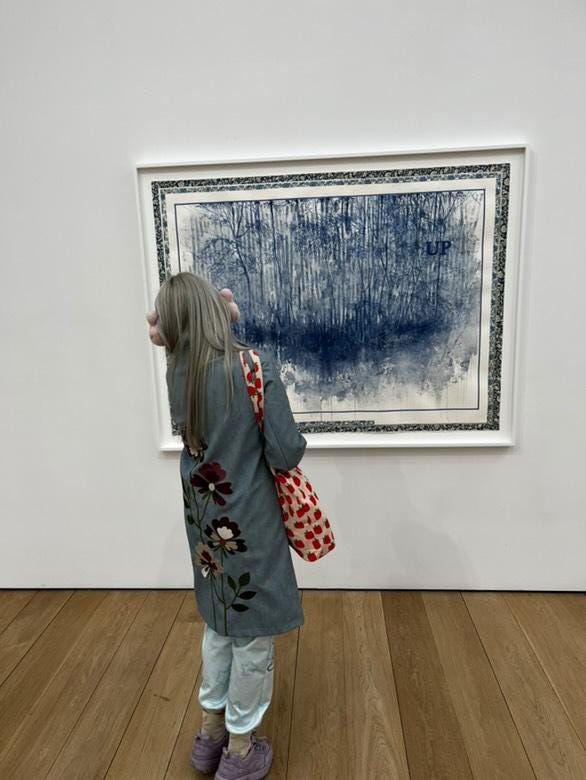
Leaving the Armory, I walked along the edge of the rail yard while the late afternoon light collapsed slowly into twilight. Wind moved between the steel fencing and over the tracks. Signal lights blinked at irregular intervals across the darkening infrastructure. Behind me, the fair still vibrated with its own peculiar atmosphere of spectacle: crowded aisles, collector chatter, champagne flutes and bubbles, white walls, reflected light, and the constant stream of movement of bodies orbiting images. The Armory always produces a heightened perceptual state where artworks compete simultaneously for attention and permanence. Everything insists upon itself at once. I have many thoughts about art fairs, and maybe one day I’ll even share them.
Even outside, the buzz remained active in my nervous system.
Images persisted in fragments. Polished surfaces. Projected light. Voices overlapping into indistinguishable ambient texture. Sculptures glimpsed peripherally then lost again within the density of spectators and booths. Contemporary art fairs often produce a strange sensory compression in which individual works begin to dissolve into a larger atmospheric field. The experience becomes less about isolated objects and more about the accumulation of signals.
One work continued returning to me with unusual clarity.
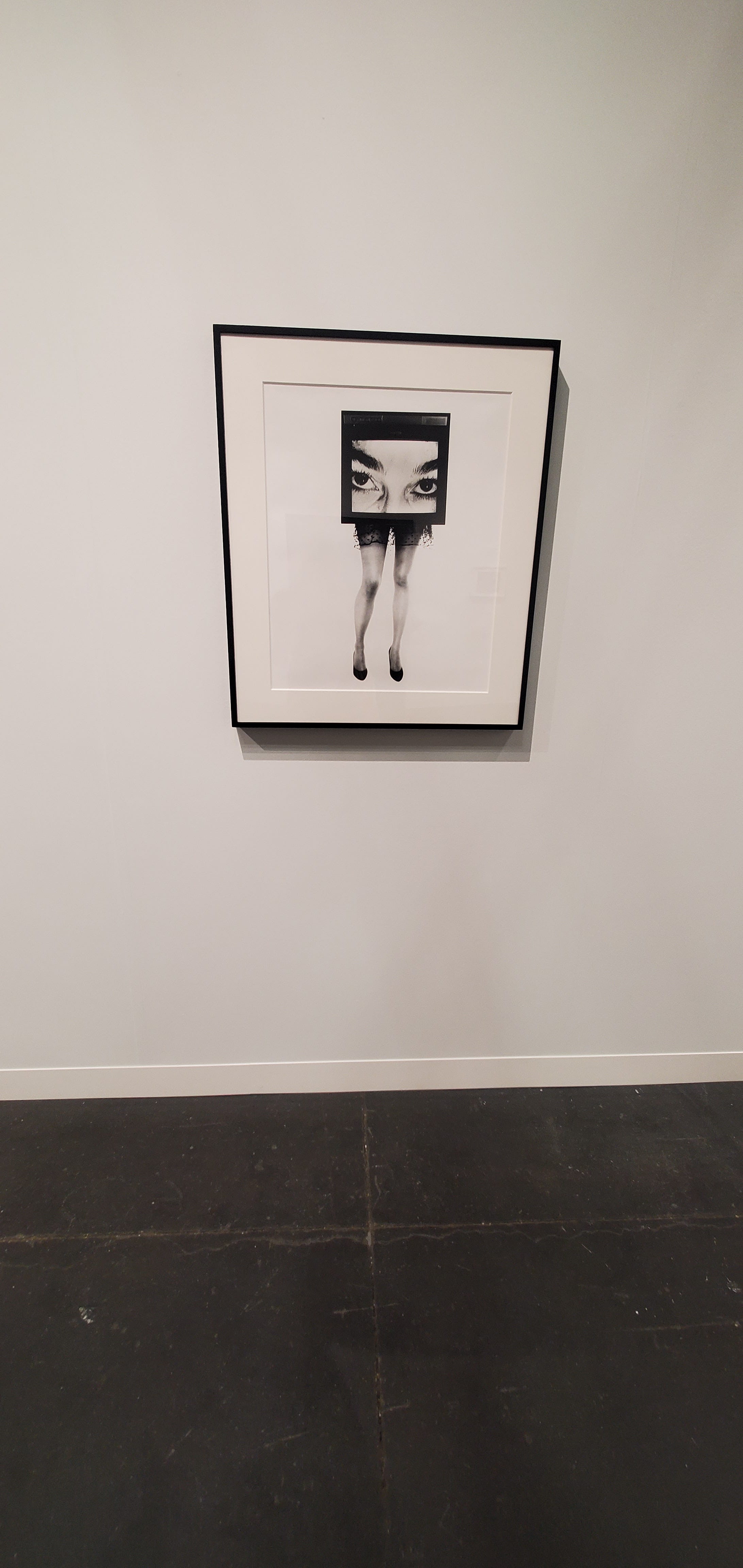
An upside-down CRT woman-creature assembled from stacked Sony television suspended in a distorted bodily formation. I encountered the piece almost accidentally while moving through the fair and felt immediately arrested by it. I’ve written of this artist before; but, hold that thought. The figure appeared simultaneously technological and mythic, like a devotional idol reconstructed from obsolete consumer electronics. Its screen behaved less like devices than organs. Not windows, but anatomical extensions. The work carried a psychological charge I recognized instantly: the unstable boundary between personhood and technological mediation. This construction of something blending both feminine and machine.
I could not stop thinking about it.
At the time, I had been reading Down Below while developing a body of digital collage works concerned with avatars, dolls, recursive self-images, and technologically distributed identity structures. My desktop had already become crowded with fragments: low-resolution screenshots, scanned textures, CRT artifacts, ball-jointed dolls, webcam captures, synthetic faces, mirrors, layered interfaces. I was thinking obsessively about proxy selves. About the strange emotional experience of extending consciousness outward into images, profiles, archives, and devices until identity itself began to feel environmentally distributed.
The work did not feel foreign to these thoughts. It felt adjacent to them. Like encountering a transmission already operating at a similar frequency.
Pink is for the Girls
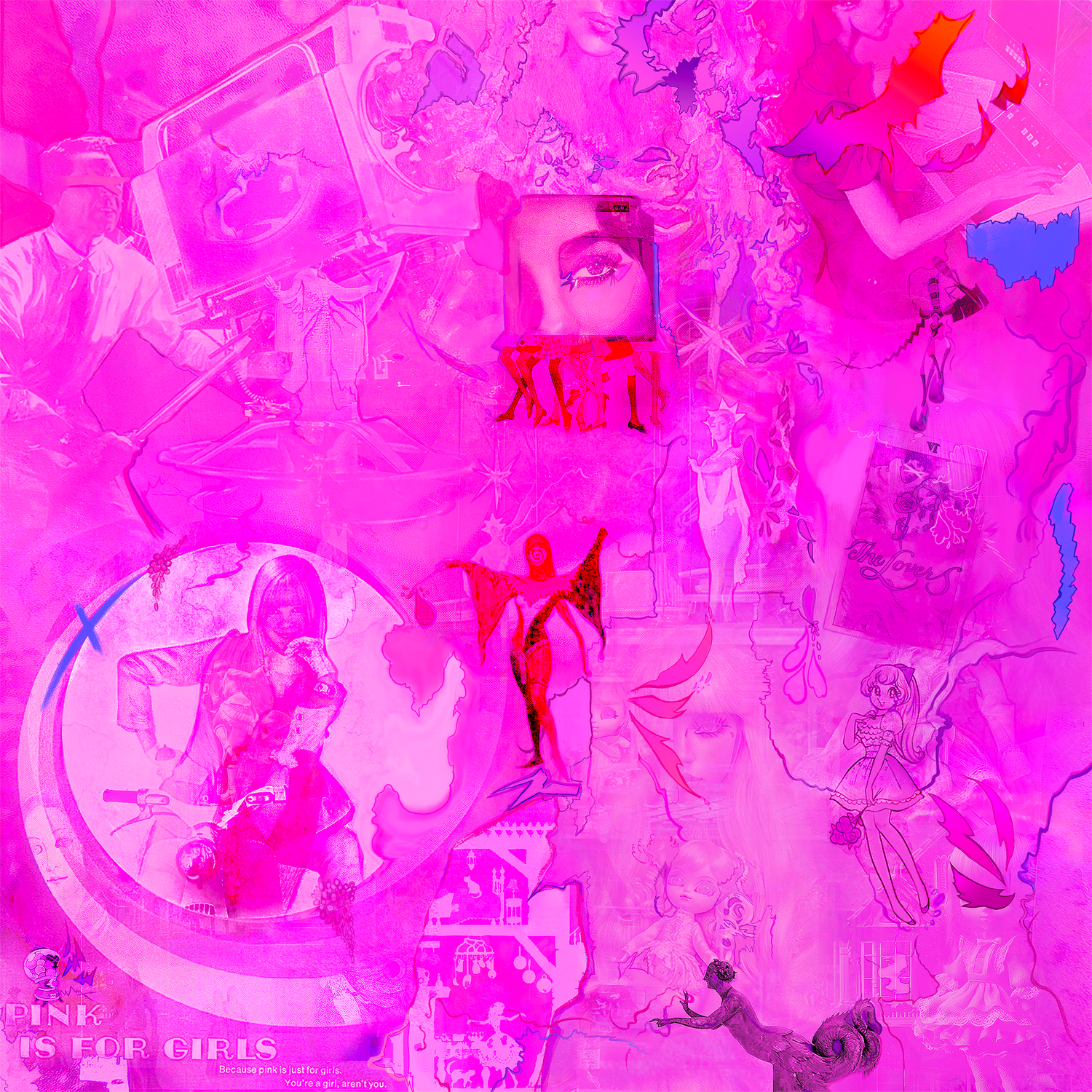
not all of me was proxy
2025/2026
24” x 24”
Welcome to the pink playground. proxy operates through accumulation.
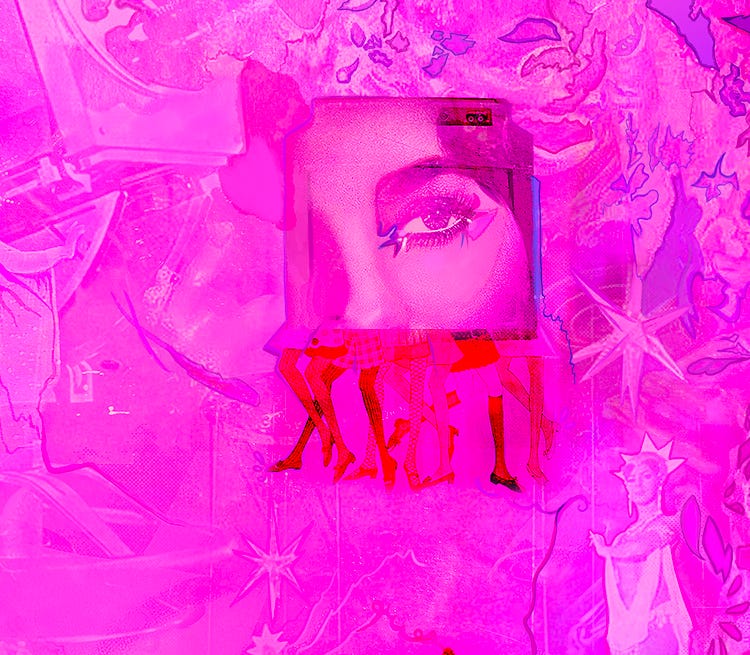
The image’s surfaces behave more like overlapping transmissions than a singular scene. Layers emerge gradually: synthetic pinks, fractured reflections, doll fragments, interface windows, CRT textures, recursive faces, compressed image artifacts. The composition oscillates between intimacy and technological distance. A figure appears, disappears, then reconstitutes elsewhere within the frame.
The work resists stable embodiment.
Instead, identity disperses across screens, mirrors, proxies, and replicated surfaces until the image itself begins behaving like a distributed nervous system. Faces recur in altered form. Expressions flatten into masks. Reflections multiply faster than the eye can fully stabilize them. What initially reads as portraiture slowly destabilizes into something environmental. The piece looks back; the gaze, considered.
The body becomes infrastructural.
Throughout the composition, dolls and synthetic figures appear suspended between objecthood and personhood. Their presence recalls the emotional ambiguity of avatars, mannequins, ball-jointed dolls, VTuber rigs, profile images, and digitally constructed selves: entities simultaneously inhabited and projected onto. They function less as characters than as vessels for digitally mediated experience. Contemporary life increasingly demands this kind of fragmentation. Versions of the self disperse continuously across platforms, archives, chats, feeds, recordings, usernames, photographs, and algorithmic systems until identity no longer feels singular or locally contained.
The CRT textures are central to this psychological atmosphere.
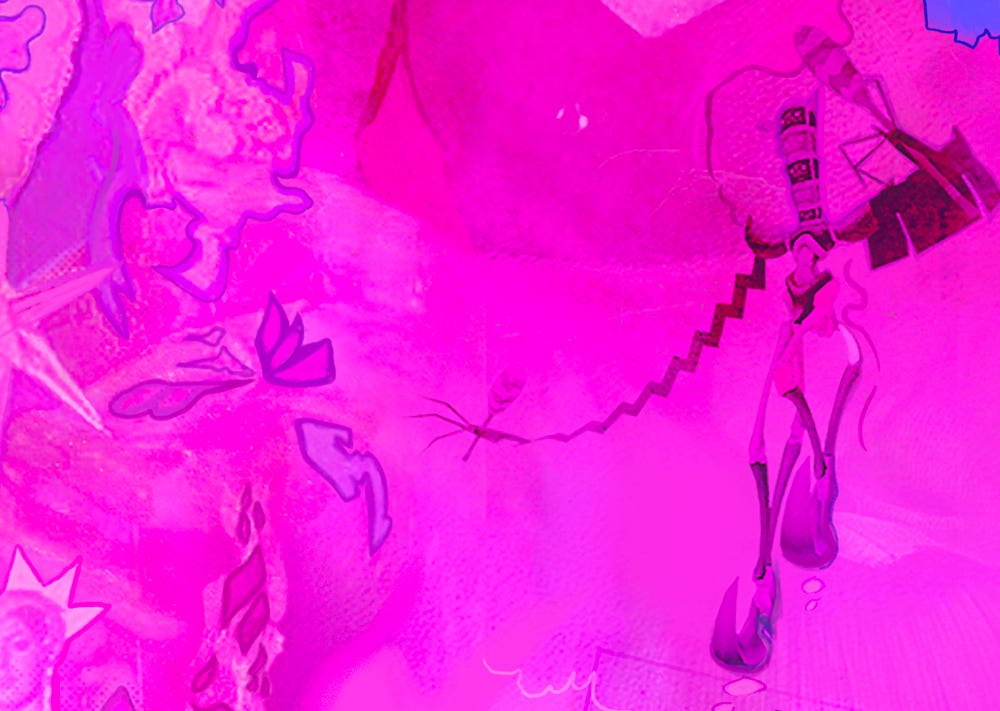
Scanlines, compression artifacts, low-resolution surfaces, and analog distortions interrupt the fantasy of seamless digital presence. The image refuses clarity. Instead, it foregrounds mediation itself: transmission delay, signal degradation, recursive copying, visual noise. These interruptions are not aesthetic decoration or nostalgic reference. They function structurally. The degraded image becomes a more accurate emotional representation of contemporary subjectivity than high-definition coherence ever could.
To exist online is often to encounter oneself recursively and incompletely.
A screenshot of a photograph. A reflection inside a livestream window. A filtered face viewed through another device. An archive resurfacing years later outside its original emotional context. Identity becomes iterable. Compressible. Transferable. The self circulates as image long before it stabilizes internally.
Yet despite this fragmentation, the work remains deeply emotional.
The pink saturation produces an almost devotional atmosphere. Beneath the technological layering is an unmistakable longing for contact, coherence, recognition, and continuity. The work does not depict technological mediation as cold or inhuman. Instead, it asks what forms of tenderness, projection, dissociation, and desire emerge once consciousness extends itself continuously through machines.
The proxy, after all, is rarely false.
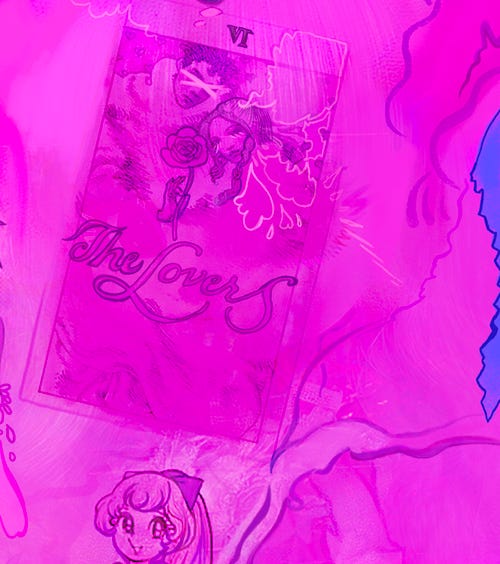
More often, it becomes an externalized fragment of the self carrying emotional residue the body itself cannot fully contain. Here, we also encounter The Lovers; we’re faced with a choice. Actively choosing which path to move toward, what mask to assume; divining who we are.
Relationship Status
It’s Complicated
There is a particular instability that emerges once images become environmental.
Earlier forms of portraiture implied distance between subject and representation. A painting, photograph, or sculpture might document a person, symbolize them, or preserve some fragment of their likeness, but the boundary between body and image largely remained intact. Networked digital culture destabilized this separation. Images no longer simply depict identity. They participate in constructing and distributing it in real time.
The self now exists across continuous systems of mediation.
Profiles update automatically. Archives resurface algorithmically. Fragments of personality circulate independently through screenshots, recordings, reposts, cached pages, chat logs, tagged photographs, and recommendation feeds. Contemporary identity often feels less like a singular interior condition than an ecology of partially synchronized proxies operating simultaneously across platforms and temporalities.
This transformation has also altered how artists encounter influence itself.
Images no longer arrive in isolation. They emerge through endless proximity to other images: tabs left open, saved folders, scrolling feeds, layered references, embedded histories, screenshots detached from original contexts. Artistic lineage increasingly behaves less like direct inheritance and more like atmospheric exposure. One absorbs visual language continuously, often before conscious recognition fully occurs.
After encountering the work at the Armory, I emailed the artist Lynn Hershman
Leeson. To my surprise, she replied.
I wrote from a place of genuine admiration. At the time, I was actively developing related imagery involving CRTs, dolls, recursive feminine figures, and technologically mediated selves. The resonance felt immediate and energizing, like briefly locating another signal operating nearby within the same conceptual frequency range. But the exchange that followed introduced a tension I had not fully considered with sufficient seriousness: where influence ends and appropriation begins within environments defined by infinite reproducibility.
The interaction stayed with me not because it felt scandalous, but because it revealed something structurally important about contemporary image culture.
Digital environments encourage continuous circulation while simultaneously intensifying anxieties around authorship, ownership, replication, and attribution. Images move frictionlessly across platforms while artists remain materially vulnerable within economic systems still dependent upon originality and control. The result is a contradictory cultural condition where circulation is both foundational and threatening.
The proxy extends beyond identity into the image itself.
Contemporary artworks now exist not only as objects, but as photographs, reposts, documentation, screenshots, fair booth installations, compressed JPEGs, recommendation engine fragments, and social media residues. Most viewers encounter artworks first through mediated circulation rather than physical presence. The image develops secondary lives almost immediately after entering public space.
In this sense, the work I encountered at the Armory had already become partially distributed before I ever saw it.
And perhaps that is the deeper instability contemporary artists increasingly confront: once images enter the network, they cease remaining entirely singular while never fully escaping authorship either. They persist in an unresolved state between object and transmission.
Studio Visions
What lingered with me afterward was not only the exchange itself, but another image from the fair I kept returning to mentally: an installation view where one of Andy Warhol’s works appeared lifting Botticelli’s Birth of Venus.
The contrast felt unintentionally perfect.
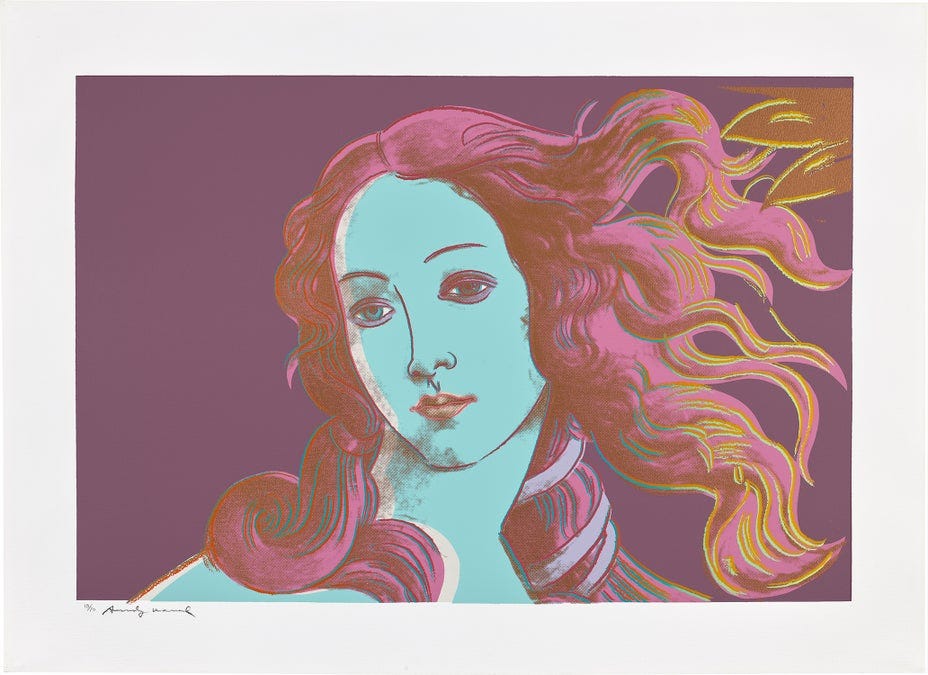
Warhol’s practice has become nearly impossible to separate from questions of replication, appropriation, authorship, and mechanical circulation. His silkscreens transformed already-public images into unstable repetitions where originality itself became difficult to locate. Celebrity photographs, advertisements, newspaper images, commercial graphics, devotional iconography: Warhol absorbed existing visual language and returned it altered through scale, repetition, fragmentation, and context.
At what point does an image cease belonging exclusively to its maker?
The question becomes increasingly difficult to answer historically. Renaissance workshops relied heavily upon assistants, repetitions, and inherited compositional structures. Religious iconography circulated across generations through adaptation and variation. Mythological imagery persisted through continuous reinterpretation. Modernism mythologized originality while simultaneously depending upon quotation, rupture, collage, and reference. Contemporary digital culture accelerated this process further until influence itself became nearly atmospheric.
No image emerges from isolation.
Artistic lineage operates through accumulation, adjacency, reinterpretation, citation, resistance, distortion, devotion, and return. Images migrate across centuries, carrying fragments of earlier meanings while acquiring new ones. To encounter art history seriously is to recognize consciousness itself as partially collaborative. Every artist inherits visual language already in motion before they arrive.
This does not eliminate the reality of authorship or ethical responsibility. Boundaries matter. Context matters. Material consequences matter. However, contemporary image culture increasingly destabilizes older assumptions regarding singular ownership because images now circulate continuously through systems designed for replication, compression, reposting, indexing, and redistribution.
The contradiction is difficult to escape.
Artists are encouraged to produce endlessly referential work within environments built upon image saturation while simultaneously defending the singularity of authorship inside economies still dependent upon scarcity and distinction. Influence becomes unavoidable at the exact moment originality remains professionally essential. Indeed, we are no longer in the age of information but in the age of influence.
Perhaps this is why the proxy feels so culturally resonant now.
Not simply because people perform themselves online, but because images themselves have also become proxies: detached from origin points, recursively circulated, emotionally absorbed, and reanimated across contexts far beyond their initial creation.
Daily Liturgy
Despite this saturation of proxies, something always remains outside transmission.
The body continues insisting upon itself.
No archive fully contains memory. No profile stabilizes identity permanently. No image captures sensation at the scale it is actually lived. Pain resists representation. So does grief. So does touch. Even the most exhaustive digital self-documentation leaves enormous portions of existence untranslated.
Perhaps this is why obsolete technologies remain emotionally resonant to me.
CRTs flicker. Analog signals decay. Magnetic interference becomes visible. Compression artifacts surface openly rather than concealing themselves beneath seamless interfaces. These systems reveal mediation instead of disguising it. Their instability feels psychologically honest.
The contemporary internet increasingly encourages frictionless identity performance. Profiles smooth contradiction into coherence. Platforms reward legibility, recognizability, optimization, continuity. Yet lived experience rarely behaves this way internally. Consciousness is discontinuous. Emotional states conflict. Memory distorts itself. The self fragments under pressure, reforms, disperses, returns altered.
The proxy can extend the self, but it cannot fully replace embodiment.
This tension became central while working on not all of me was proxy. The title emerged almost accidentally, yet it clarified the underlying emotional structure of the piece. Beneath the recursive imagery, synthetic figures, mirrored interfaces, and distributed identities existed a quieter realization: some portion of the self always remains materially unresolved.
Unrendered.
Headed Home
The light had nearly disappeared by the time I reached the station.
The rail yard glowed intermittently beneath the deepening blue of early evening. Red signal lights blinked across the tracks while windows illuminated one by one in distant towers. Trains moved continuously through the city carrying bodies, images, information, advertisements, memories, and exhausted versions of ourselves homeward through overlapping systems of transmission.
I kept thinking about proxies.
About the strange contemporary experience of existing simultaneously as body and image. About how much of modern life now unfolds through representations of the self moving independently through networks we can no longer fully perceive. About how identity disperses into archives, feeds, recordings, screenshots, chats, mirrors, surveillance systems, and algorithmic reflections until the boundary between person and projection becomes increasingly unstable.
Yet beneath all this mediation, something continues resisting complete translation.
Something remains outside the archive.
The body ages. Desire shifts. Grief alters perception. Memories distort themselves. Pain interrupts performance. Intimacy exceeds representation. No matter how many proxies we generate, some portion of the self persists beyond visibility, beyond circulation, beyond compression into coherent image.
Perhaps this is why obsolete technologies remain emotionally powerful.
CRTs hum. Analog signals decay visibly. Images flicker under interference. These systems reveal the instability contemporary digital culture often attempts to conceal. They remind us that every act of transmission also contains distortion, loss, delay, residue, and noise.
Maybe that is what I recognized both in the work at the Armory and later in my own reaction to it: not simply technological mediation, but the emotional reality of trying to locate oneself within endless systems of representation.
What happens to identity once images become environmental?
Where does influence end and inheritance begin?
How do artists meaningfully participate in image culture without becoming consumed by endless cycles of replication and ownership anxiety?
What forms of embodiment still resist technological translation?
What remains materially human beneath the archive of the self?
And what parts of us continue flickering beneath the signal, unresolved but still present?
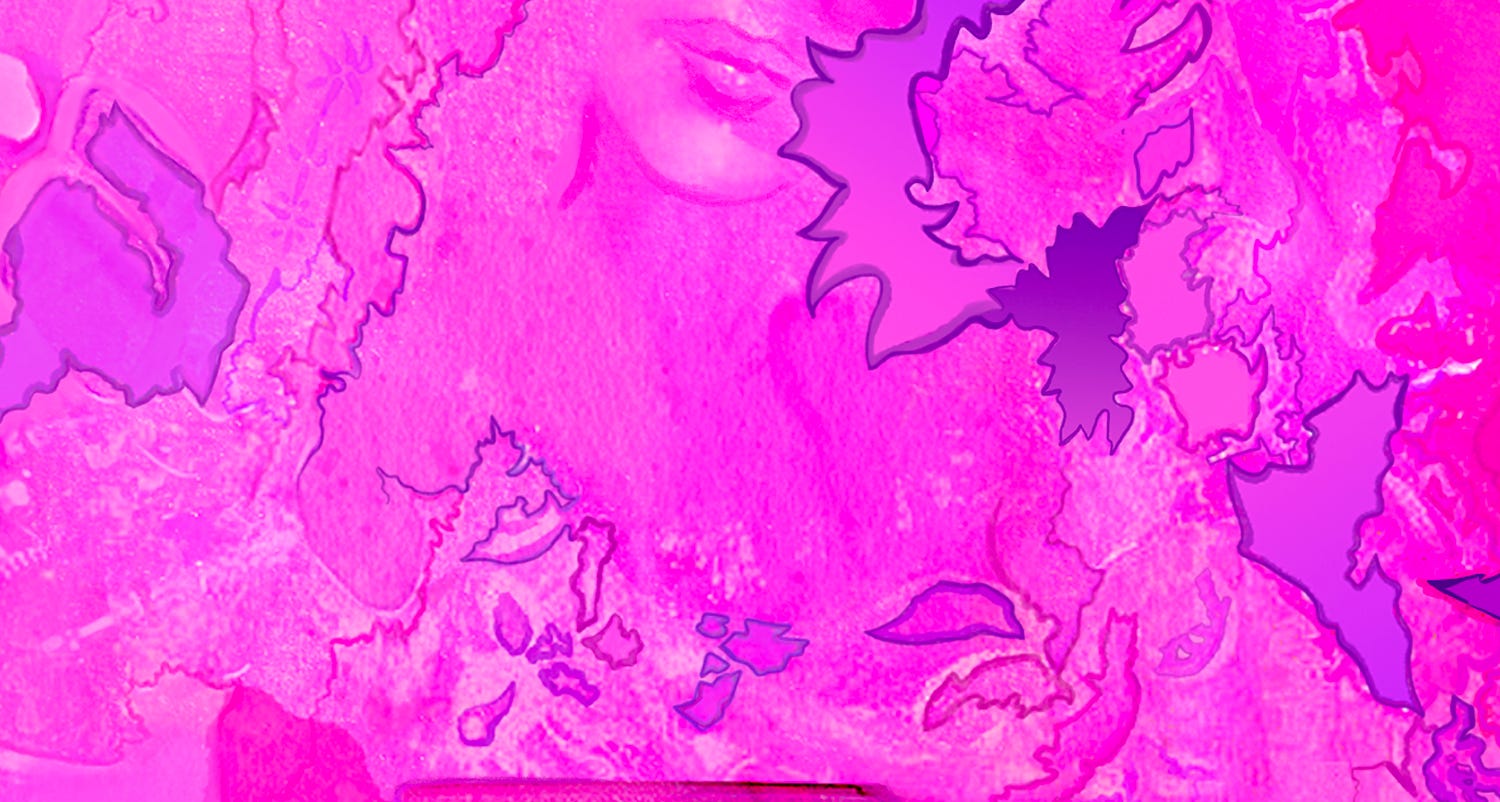
Learn more about my artist practice on my portfolio site.